DKI Residents Are Not Ready to Face the New Normal
Jakarta, 5 July 2020 For about a month since the implementation of Large-Scale Social Restrictions (PSBB) transitioning to the new life order or "New Normal" phase, the number of additional Covid-19 cases in the DKI Jakarta area has continued to increase. Along with the increasing number of molecular-based tests carried out, case transmission is still showing an increase.
PRESS RELEASE
DKI Residents Are Not Ready to Face the New Normal
Jakarta, 5 July 2020 For about a month since the implementation of Large-Scale Social Restrictions (PSBB) transitioning to the new life order or "New Normal" phase, the number of additional Covid-19 cases in the DKI Jakarta area has continued to increase. Along with the increasing number of molecular-based tests carried out, case transmission is still showing an increase. At the same time, users of Transjakarta and Commuter Line public transportation have experienced a gradual increase, requiring special attention and monitoring as part of preventing the spread of COVID19. As of Monday (28/7) Transjakarta users reached 200,000 even though only 29 routes run.
Through the Active Case Finding Program, the Health Service has even discovered that Corona virus transmission occurred in a number of traditional markets with 345 positive traders. There are at least 303 traditional markets spread throughout DKI Jakarta, but to date the DKI Jakarta Provincial Government has only carried out tests in 128 markets.
Referring to the World Health Organization (WHO) reference, one of the conditions for easing social restrictions is a positivity rate below 5%, which means that the percentage of positive patients tested on a molecular basis is no more than 5%. Especially for DKI Jakarta, although there is a downward trend, the average positive rate in DKI Jakarta has increased several times. In fact, on June 26 2020 the positivity rate reached 7.1%. This means that the average positive number is still fluctuating.
In response to this, LaporCovid-19.org together with the Social Resilience Lab, NTU conducted a survey-based study to map residents' risk perceptions of Covid-19. This study was conducted from 29 May to 20 June 2020 and succeeded in getting more than 200,000 respondents spread throughout the DKI Jakarta area. After the validity test was carried out, there were a total of 154,471 valid respondents. Previously, in the first four days of the study period, there were 3,079 valid respondents. At that time we found that the perception of DKI residents towards New Normal tended to be less prepared (3.46).
Methods and Results
Using the Quota Sampling Method based on population variables per sub-district, an online survey was conducted via the Qualtrics platform which was distributed via the instant messaging application (WhatsApp) to residents of DKI Jakarta. Distribution of the survey was carried out through the Indonesian Red Cross (PMI) network, the DKI Jakarta Governance Bureau, several sub-district heads in DKI Jakarta, and the community community network.
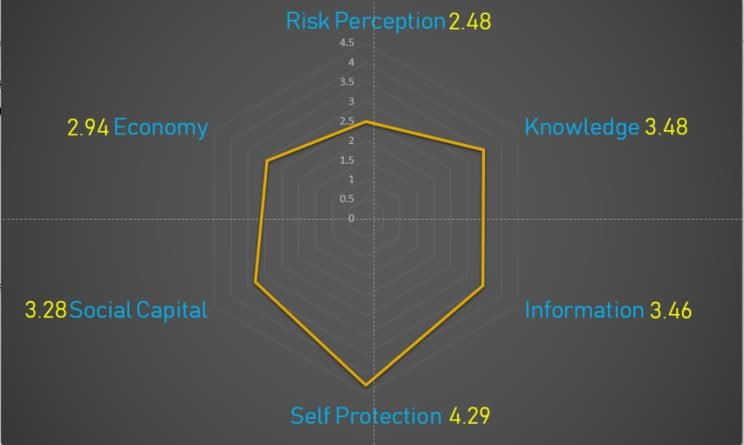
This study uses three analytical methods, namely descriptive statistics to obtain a demographic picture of respondents as well as basic information related to study variables; Spearman rho analysis to measure correlation between variables and demographic factors; and the risk perception index measurement formulation (Risk Perception Index) which is used to measure the general trend of respondents' risk perceptions regarding the pandemic situation by including 6 variables, namely Risk Perception, Self-Protection, Information, Knowledge, Social Capital, and Economy.
As many as 65.2% of respondents were women. From the educational aspect, the majority of respondents were high school graduates (58.47 percent) and bachelor's degrees (19.39 percent). Most of the respondents were housewives (47.28 percent), followed by private workers (21.60%) and students at only 2.3 percent. In terms of health risks regarding Covid-19 infection, 85.76 percent of respondents admitted that they did not know/did not have comorbidities.
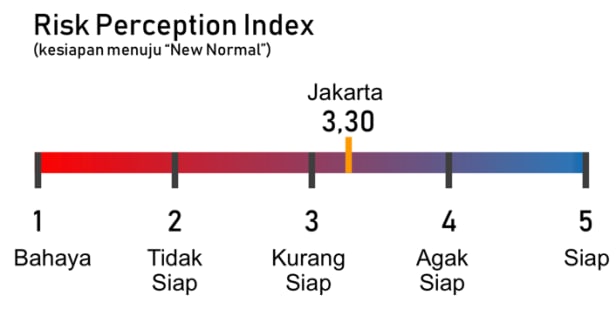
Overall, Jakarta's Risk Perception Index (RPI) score was 3.30 (scale 5) or a decrease of 0.16 from the findings at the start of the study. Descriptively, this score means that DKI residents generally have a level of risk perception that tends to be rather low. If translated into policy language, this score indicates that DKI residents are still insufficiently prepared to enter the New Normal era where socio-economic activities are fully opened.
Apart from the low RPI scores, there were three important findings from this risk perception survey. First, overall DKI residents have good self-care behavior. This is shown by the high score of the Self Protection variable which covers three main aspects, namely wearing masks, maintaining distance and washing hands. But on the other hand, the value of the risk perception variable is very low. This indicates the strong tendency of DKI residents to underestimate the Covid-19 outbreak. Most respondents believed that their chances of contracting Covid-19 were very small. This correlates with economic conditions where the majority of respondents felt the economic impact significantly, thus influencing perceptions of the risk of Covid-19.
This survey was led by Sulfikar Amir (+62 821-1728-6288) from NTU, one of LaporCovid-19's expert collaborators
The rebroadcast can be watched on the channel YouTube Reports Covid 19
Please download the following press release via this link
Presentation Materials Sulfikar Amir, PhD
Elisa Sutanudjaja's Presentation Material
Map of Average Risk Perception Index for DKI Jakarta
High resolution processed maps can be downloaded here
Processed by:
Jonathan Hardianto Wibisono
Researcher at Rujak Center for Urban Studies