DKI Residents Ready for PSBB 2.0
Overall, we found that DKI Jakarta residents are more aware of the Covid-19 pandemic compared to three months ago. This awareness emerged because of the increasing number of people affected by Covid-19. At the same time, we found that 24% of residents experienced a change in employment status during the pandemic. This group includes those who have lost their jobs until now, those who have changed their minds to becoming entrepreneurs, and those who have been affected by...
PRESS RELEASE
DKI Residents Ready for PSBB 2.0
Jakarta, 17 September 2020 – Currently, DKI Jakarta is re-implementing the second Large-Scale Social Restrictions (PSBB 2.0) to reduce the number of people infected with Covid-19. This policy was taken after the increasing number of positive confirmed cases of Covid-19 which threatened the availability of health facilities and services in DKI Jakarta.
Data in the field shows that although the number of PCR tests carried out in DKI Jakarta has increased, even four times greater than WHO standards, at the beginning of September 2020, the positive ratio for Covid-19 in the DKI Jakarta area ranged from 10.4-16.5 percent. Even though WHO's minimum standard for allowing regional easing is below 5 percent. This means that the rate of spread of the corona virus in the DKI Jakarta area is still quite rapid.
In the last month, cumulatively, the number of positive cases in DKI Jakarta as of September 10 reached 51,287. The number of deaths reached 1,365 people who were confirmed positive, while 2,302 people died with suspect status and 1,734 with probable status. Among those who died, there were at least 24 health workers.
Responding to this situation, LaporCovid-19 together with the Social Resilience Lab of Nanyang Technological University (NTU) Singapore conducted a survey of the psychosocial conditions of the people of DKI Jakarta in the context of implementing PSBB 2.0. The aim of this survey is to measure the level of acceptance of the people of DKI Jakarta towards the implementation of the second PSBB.
Methods and Results
The survey was conducted online from September 11 to September 14 2020 using the Quota Sampling method based on population variables per sub-district. The survey was distributed using an instant messaging application (WhatsApp) to DKI Jakarta residents through the LaporCovid-19 networking community and the DKI Jakarta Provincial Government.
The survey succeeded in getting 82,655 respondents who were spread evenly throughout the DKI Jakarta area. After carrying out the validity test, there were a total of 81,734 respondents for further data processing.
This study data processing uses three analytical methods, namely descriptive statistics to obtain a demographic picture of respondents as well as basic information related to study variables; Spearman rho analysis to measure correlation between variables and demographic factors; and measurement formulation using the method mapping Covid Mood.
CovidMood is a quantitative research method used to analyze people's emotional feelings using semantic differential scale.There are two variables measured, namely public satisfaction with government policies and public happiness with the socio-economic situation.
As many as 65.38% of respondents were women. In terms of age, the largest number of respondents were 36-45 years old at 33.35%, followed by respondents aged 46-55 years at 28.64%. Meanwhile, in terms of work, housewives were the largest number of respondents (48.02%).
Findings
Overall, we found that DKI Jakarta residents are more aware of the Covid-19 pandemic compared to three months ago. This awareness emerged because of the increasing number of people affected by Covid-19. At the same time, we found that 24% of residents experienced a change in employment status during the pandemic. This group includes those who have lost their jobs to date, those who have changed their minds to becoming entrepreneurs, and those who have been affected by salary cuts. Regarding the recommendation to work from home (WFH), we found that only 35% were fully able to do WFH and 26% could do some of their work WFH. Meanwhile, there are 20% whose livelihood requires them to work outside the home, 17% can only do WFH occasionally, and 2% who are not allowed to WFH by their workplace.
CovidMood
We calibrate all data at the sub-district level to get the coordinates on the CovidMood map. The results can be seen in the picture where all output, except the tank, is in the quadrant Optimistic (yellow star is the midpoint of the overall data plot with a variance level of 0.53)
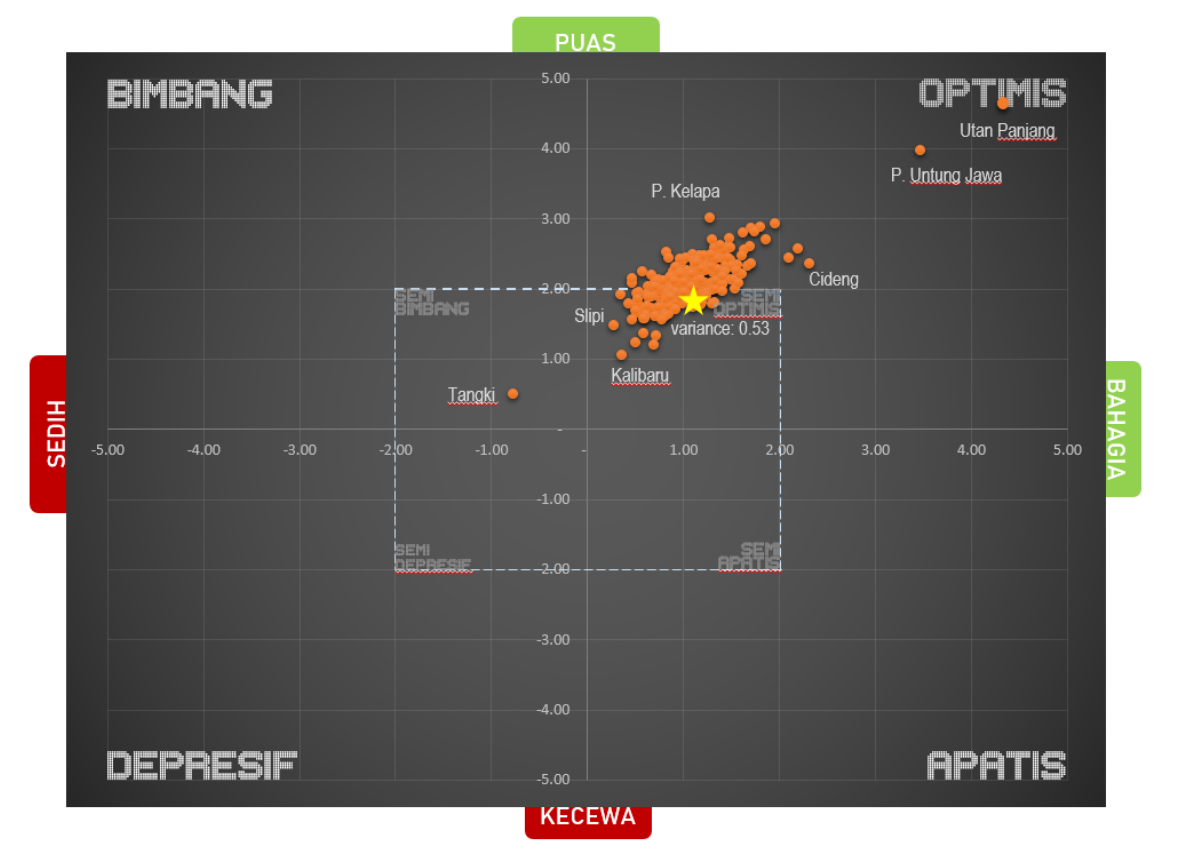
The CovidMood map consists of two axes: horizontal shows the emotional atmosphere felt by citizens regarding the socio-economic situation, while vertical shows citizens' feelings regarding government performance. The horizontal axis coordinates are measured using 5 questions, and the vertical axis coordinates are also measured using 5 questions. The scores for all questions are shown in the following table:
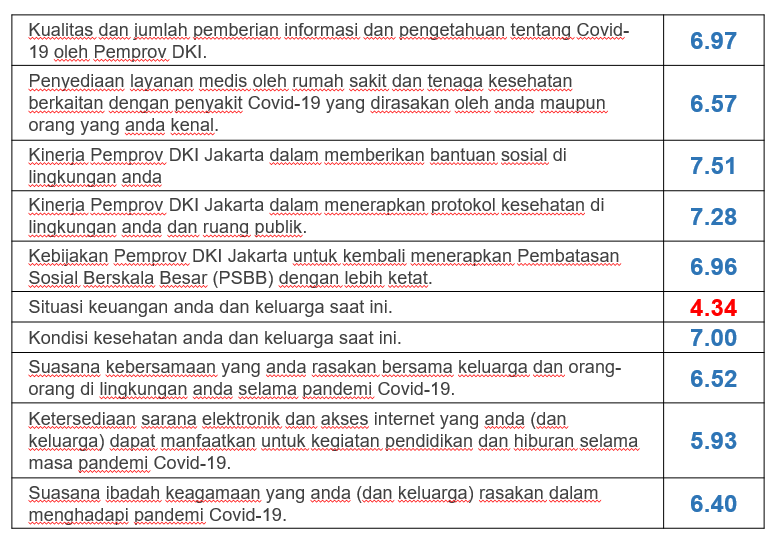
The results of this survey are that the people of DKI Jakarta are in a conducive psychosocial atmosphere to support the implementation of the PSBB. And that means that DKI residents have a good level of compliance and are able to survive psychosocially even if the PSBB policy is tightened. The data above shows that public support for government policies is high enough where the score for this variable reached 6.96 (scale 10). From all these findings, we conclude that the DKI Jakarta community's acceptance of PSBB 2.0 high enough and public trust in the DKI government strong.
Please download this press release via the following link
Presentation materials in the press release can be downloaded via the following link